
From Service to Science: Veterans, Hearing Loss & the Legacy of Dr. Jack Hough
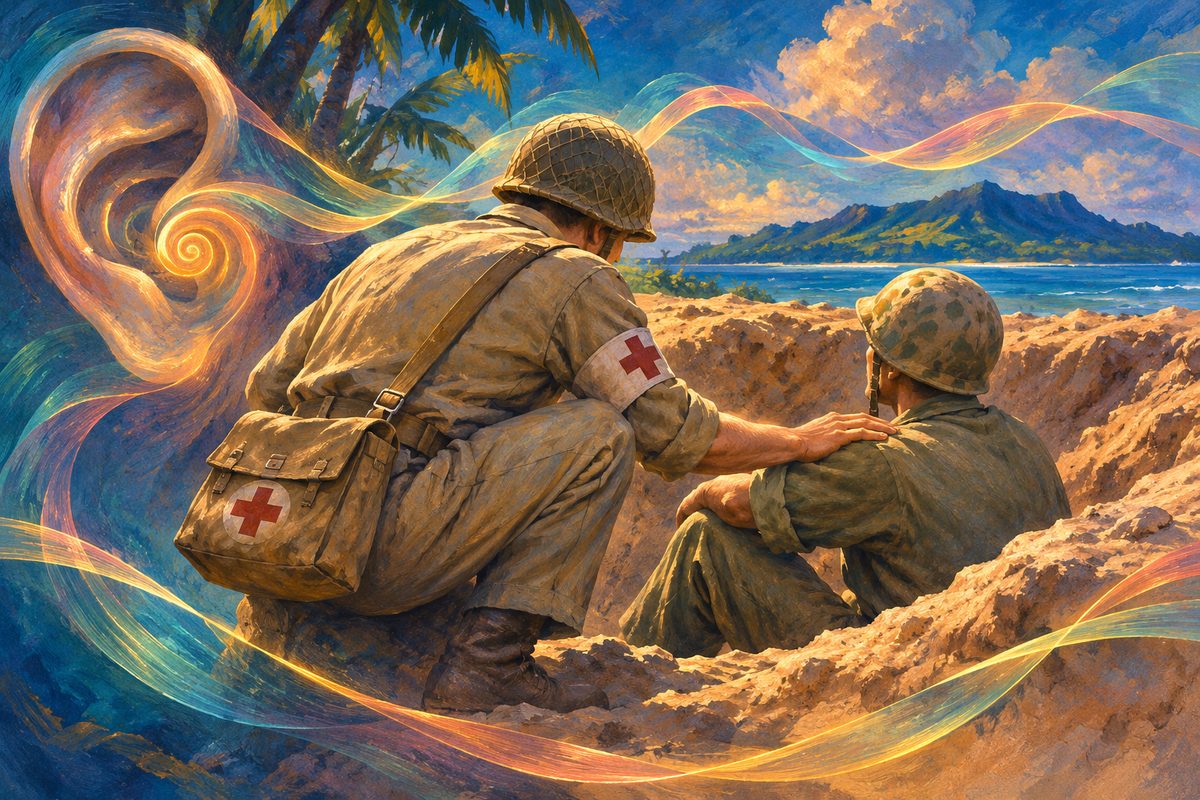
Before there was a Hough Ear Institute, there was a young doctor on Iwo Jima, trying to reach the wounded.
During World War II, Dr. Jack Hough served as a battalion surgeon alongside Marines. Decades later, he recalled landing in the first wave and caring for men under mortar and artillery fire.
He described moving from one shell hole to another. The craters offered protection, but reaching wounded men meant leaving that shelter and crossing exposed ground.
Once, he remembered looking back after leaving a shell hole and seeing it explode, killing those inside. He also recalled having his pack blown off his back.
He was afraid. He never pretended otherwise.
“You just did it because it needed to be done,” he said.
While Jack was fighting, his wife, Jodie, was giving birth to their oldest son. Neither knew what was happening to the other. His parents received condolences because he was believed dead.
Jack survived. In his telling, that survival deepened his Christian faith and his sense that God had a purpose for his life.
A lifetime of answering the call
His service with the 4th Marine Division at Iwo Jima earned him a Bronze Star. After the war, he returned to Oklahoma and began a medical career that would reach far beyond his home state.
Dr. Hough became a pioneer in microscopic ear surgery, developing techniques and instruments to help restore hearing. He assembled a team of surgeons, audiologists, scientists, and engineers who brought different skills to a shared question: How could they do more for people with hearing loss?
That work helped establish the foundation for Hough Ear Institute. Today, we continue his mission of restoring hearing worldwide through research, teaching, and humanitarian efforts.
There is something deeply moving about considering those chapters of his life together. A physician who once crossed a battlefield to reach the wounded would spend decades seeking better ways to care for others.
His willingness to serve became a legacy that continues beyond his lifetime.
For millions of veterans, the effects of service remain
As Veterans Day approaches, Dr. Hough’s story also reminds us to consider the challenges veterans carry home.
Military service can involve exposure to intense noise from weapons, aircraft, machinery, and explosions. That exposure can damage hearing and contribute to tinnitus—the perception of ringing, buzzing, or other sounds without an outside source.
The scale of the need is striking.
Tinnitus is the most prevalent service-connected disability among veterans receiving VA disability compensation. In fiscal year 2025, more than 3.58 million veterans received compensation for tinnitus, while more than 1.69 million received compensation for hearing loss. These conditions affect overlapping groups of veterans, and the numbers reveal an enormous need for continued care and research.
Behind every number is a person. Someone trying to follow a conversation with a spouse, hear a grandchild’s question, or find relief from ringing that follows them even into a quiet room.
Hearing challenges can make familiar moments require more effort: a family dinner, a conversation with friends, a question asked from across the room. For someone with tinnitus, even quiet may offer little relief from unwanted sound.
Homecoming matters. So does life afterward.
The need is enormous. It gives our work urgency—and makes your support of Hough Ear Institute matter.
Why your support matters
At Hough Ear Institute, hearing loss and tinnitus are central reasons to keep asking scientific questions and pursuing better answers.
Our work depends on people who believe that research is worth sustaining. Donations help support HEI’s efforts to advance research for those affected by hearing loss and tinnitus.
Scientific progress takes time, skilled people, and resources. It requires careful work that often happens far from public view: investigating a question, evaluating results, and using what is learned to determine the next step.
Donor support helps make that continuing effort possible.
For veterans living with hearing challenges—and for countless others affected by them—the need gives that work purpose. Behind the science are people who want to stay connected to their families, their communities, and the lives they love.
When you give to Hough Ear Institute, you help sustain the work of pursuing better answers. You also help carry forward a mission built around service to others.
Dr. Hough’s legacy lives in that commitment: seeing a need, bringing people together, and continuing to seek ways to help.
A legacy we can carry together
This Veterans Day, we remember those who served and the families who waited for them. We recognize those whose daily lives still bear the effects of their service.
And we remember a young doctor who left the shelter of a shell hole because someone needed him.
We cannot step into his footsteps on Iwo Jima. We can choose to carry his commitment to others into the work ahead.
Honor a veteran in your life with a gift to Hough Ear Institute. Help sustain the research and the hope that keep this mission moving forward.